The Story Behind Failure to Atone
"A beautiful, extraordinary, and important book! Every American should read Dr. Allen Hassan's Failure to Atone." — Ron Kovic
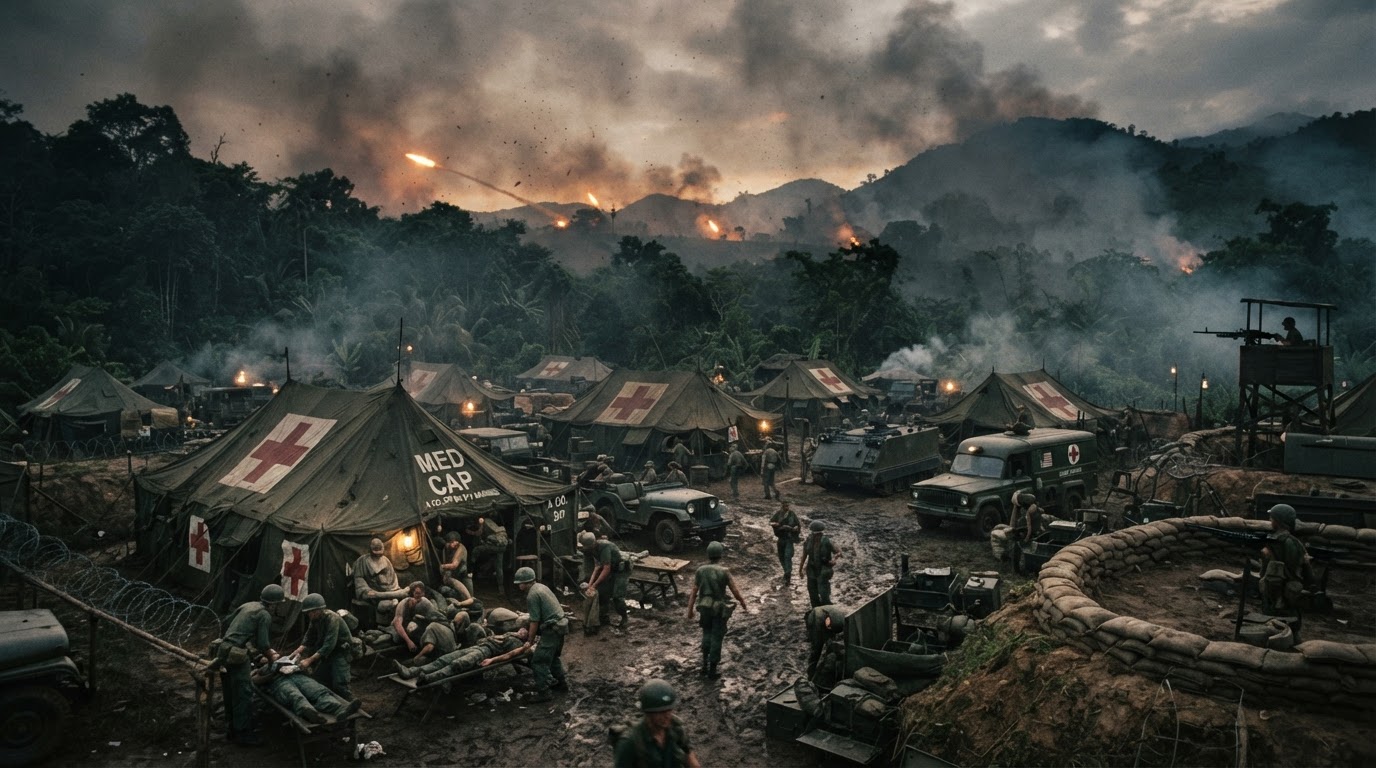
Operating Under Artillery Fire at the DMZ
Quang Tri was subjected to more tonnage of bombs than all of Germany in World War II. In the midst of this devastated earth stood an overwhelmed provincial civilian hospital.
A Moral Reckoning at the Knife's Edge
In 1968, the United States was deeply entrenched in the Vietnam War. While military medicine focused on treating combat soldiers, thousands of Vietnamese men, women, and children were caught in the crossfire—suffering devastating blast burns, amputations, and tropical diseases with virtually zero modern medical support.
To respond to this human catastrophe, the American Medical Association launched the Volunteer Physicians for Viet-Nam (VPVN) program, sending 774 civilian doctors into provincial hospitals. Among them was the youngest volunteer: 29-year-old Dr. Allen C. Hassan.
Instead of an orderly clinic, Dr. Hassan arrived at Quang Tri Provincial Hospital to find corridors overflowing with dying children, severed limbs stored in open buckets, zero running water for days, sweltering tropical heat, and constant mortar rounds rattling the operating theater.
"We were sewing together peasants who had simply been tending their rice paddies when cluster bombs rained from the clouds. The bureaucracy classified them merely as 'collateral damage.' To a surgeon holding a child's pulsing femoral artery, there is no such thing as collateral damage."
Documentary Themes
- Humanitarian Triage: How volunteer surgeons balanced surgical ethics when supplies ran dry.
- The Transformation: An Iowa Marine patriot confronting systemic military and governmental deceit.
- The Committee of Responsibility: Evacuating paralyzed children to American university teaching hospitals.
- Atonement & Reparations: Why acknowledging civilian tragedies is essential for national healing.
Written by Dr. Allen C. Hassan with David Drum
Hardcover, 271 pages, 45 historical photos, Appendix of 774 Doctors.
Inspect Bibliographic Record →Chapter-by-Chapter Breakdown
The foundational arcs adapted for the feature documentary screenplay.
I. The Call of Duty & The Farm Boy from Iowa
How an Iowa farm boy and former U.S. Marine was inspired to join the AMA volunteer mission, unaware of the carnage awaiting him in the DMZ zone.
II. Arrival at Quang Tri: Inside the Killing Fields
Stepping off the helicopter into an understaffed jungle hospital with intermittent power, limited anesthetics, and hundreds of napalm and shrapnel victims.
III. The Endless Stream of Innocent Blood
Confronting horrific burns, amputations, tropical epidemics, and bureaucratic indifference while bonding with the resilient Vietnamese people.
IV. The Moral Pivot: From Marine to Pacifist
Witnessing atrocities, official corruption, and systemic cover-ups that shattered illusions and forged an unshakeable dedication to peace.
V. The Second Tour: Rescuing the Children
Working with the Committee of Responsibility to identify paralyzed and critically injured children for specialized treatment in the United States.
VI. Ghosts of War: Fighting for the Veterans & Civilian Atonement
Decades of legal, psychiatric, and medical advocacy back home, culminating in the demand for full truth, reconciliation, and atonement.
Bring This Story to Your Audience
Film festivals, university history departments, and veteran associations can schedule preview screenings and discussions with our archival team.